The Art of Balance: Exercises for Stability
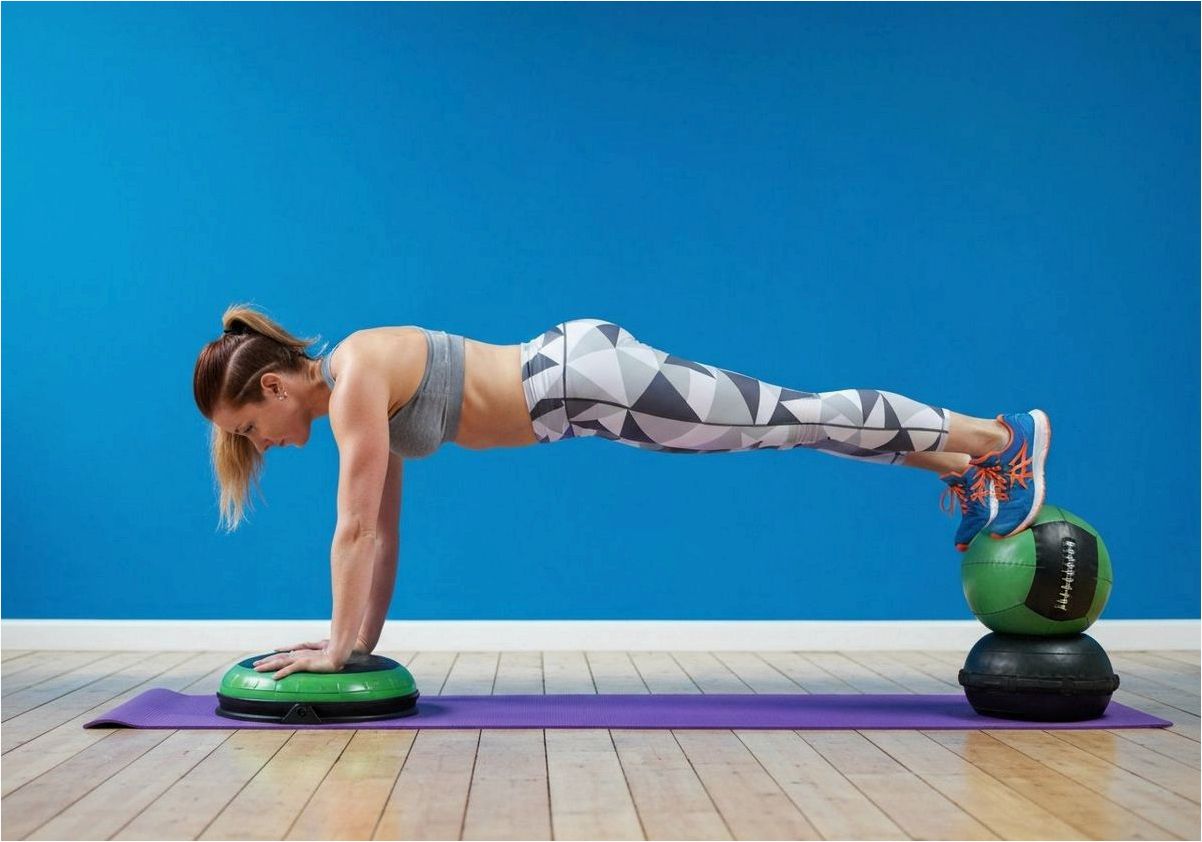
Since the introduction of innovative exercise equipment designed by fitness experts, strength training has taken on a new direction. Now, thanks to these devices, you can not only build muscle but also improve body control and maintain a steady stance.
Article Contents:
balance platforms, stability cushions, and inclined mats—although these tools differ in shape, they share one common feature: increased instability. Standing on such a “moving” surface, you feel as if you’re on the deck of a ship in a raging storm. That’s the whole point: to maintain your balance, you’ll have to actively engage your smallest stabilizing muscles, which often remain unused when working out on conventional exercise equipment. By combining this with classic squats, lunges, and twists, you’ll get significantly closer to the desired slimness and attractiveness of your figure , and confidence on your feet will become your natural state.
- Workout Schedule. Plan to train twice a week, taking 1–2 days of rest between sessions to allow for recovery. Start with two sets of 10–15 repetitions for each exercise, resting for about 60 seconds between sets. As you progress, add a third set or increase the weight of the dumbbells.
- Warm-up. To start, spend 5 minutes walking or jogging in place, or jump rope. Then do a series of side jumps with leg movements. Finish the warm-up by standing on an unstable surface, lifting each leg in turn, and performing 20 rotations with your foot in both directions.
- Cool-down. After finishing the strength training portion, it’s important to stretch the major muscle groups , holding each stretch for 30 seconds.
- Cardio workout. Don’t forget to dedicate 30–45 minutes to cardio training 3–5 times a week, combining steady-state and interval training—this will help strengthen your cardiovascular system and increase calorie burn.
- Posture correction. Regular sessions on balance trainers help improve posture by strengthening the deep core muscles this is especially important for those who spend a lot of time sitting or suffer from minor posture issues.
- Psychological benefits. Exercises performed on unstable surfaces require high levels of concentration and coordination, which has a positive effect on the nervous system and helps develop the ability to remain calm and confident in stressful situations.
Recommendations for Beginners
- These tips are especially helpful for those who haven’t done strength training in the last three months or who have no experience training on unstable surfaces.
- First, practice the movements on a flat floor so you don’t have to worry about maintaining your balance.
- Once your movements become confident, perform one set on a firm surface and the next on balance equipment without additional weight.
- After 3–4 weeks, move on to a full program using exercise equipment.
- Be sure to pay attention to your breathing: try to exhale when exerting effort and inhale when relaxing; this will help improve control and reduce muscle tension.
- Use mirrors or ask a trainer to check your form to avoid incorrect movements and minimize the risk of injury.
Side Squats
These perfectly target the quadriceps, the muscles at the back and inside of the thighs, as well as the gluteal muscles
turn to the right toward the inclined platform, placing your right foot on its edge and your left foot on the floor, with your feet slightly wider than hip-width apart. Place your hands on your waist, engage your core, and step to the right so your feet are shoulder-width apart. Squat down, shifting your weight onto your heels. Return to the starting position, bringing your left foot closer to your right. Continue moving up the platform in this manner, taking steps and squatting. Then, once you reach the top, repeat the movement downward. When you reach the bottom, turn 180° and perform the same ascent and descent, starting with your left leg. This counts as one set. Recommended dumbbell weight: 2.5 to 5 kg.
Tip: Keep your back straight and avoid leaning your torso forward—this will help distribute the load properly and protect your joints.
One-Legged Bent-Over Row
This exercise actively works the glutes, hamstrings, shoulder muscles, and back extensors.
Stand with your right foot on the balance pad, bending your left knee and keeping your left leg suspended in the air. Hold a dumbbell in your right hand, letting it hang down alongside your body with your palm facing inward. Lean forward with your back straight until your torso is parallel to the floor. Return to the starting position, pull the dumbbell up to your shoulder, then lift it overhead. After that, bend your elbow again, bringing the dumbbell back to your shoulder, and lower it down. Continue the exercise cycle for the required number of repetitions, then switch sides. Dumbbell weight: 2.5 to 4 kg.
Important: Control your movements, avoiding sudden jerks, to maintain balance and prevent injury.
Lunges with Raised Arms
This exercise targets the glutes, calves, quadriceps, and biceps.
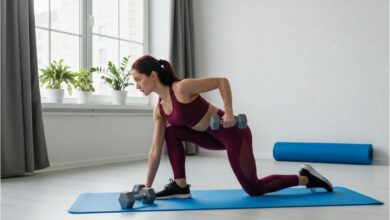
Stand facing an inclined surface with your feet shoulder-width apart, arms holding dumbbells hanging loosely at your sides, palms facing inward, and core engaged. Take a wide lunge forward with your left leg, bending your knee over your ankle, and extend your right leg straight back. At the same time, pull the dumbbells up to your shoulders, bending your arms and turning your palms toward you. Return to the starting position and repeat with the other leg. Dumbbell weight: 2.5–5 kg.
Tip: Keep your torso straight and your gaze forward—this will help improve your balance and the effectiveness of the exercise.
Handwalking
Strengthens the abs, chest muscles and shoulders, glutes, back extensors, and triceps; the legs act as stabilizers.
Get on all fours in front of the balance pad. Alternately extend your legs backward, keeping your feet together and resting your toes on the floor. Engage your abs and straighten your body so that it forms a straight line from head to heels. Place your left hand on the edge of the cushion, shifting your shoulder joint along with it—it should be directly above your wrist. Repeat the same for your right hand. Then return your hands to the starting position one at a time, starting with the right. Within a single set, switch the leading hand every fifth repetition.
Safety tip: If you are a beginner, perform the exercise near a support—such as a wall or a partner—to reduce the risk of falling.
To ensure that exercises on unstable surfaces are effective and safe, avoid the following mistakes.
DO NOT USE sudden jerks—they will disrupt your balance and may cause you to fall.
DO NOT JUMP too high, as this can lead to a loss of control.
DO NOT PLACE balance equipment on a slippery surface—this will make it too unstable.
REMEMBER to engage your core muscles during each exercise for better stability.
DO NOT use weights that are too heavy, as you would when training on a flat surface, to avoid excessive muscle gain.
Single-Leg Squat
Works the glutes, hips, middle of the shoulders, and quadriceps.
Place your right foot in the center of the balance platform, bend your left knee, and lift it slightly. Hold a dumbbell in your right hand with your elbow relaxed. Engage your core muscles , raise your left arm out to the side at shoulder height with your palm facing down—this will help you maintain balance. Slowly bend your right knee and lower yourself slightly into a squat. At the same time, raise your right arm to shoulder height, just like your left. Return to the starting position. Perform the required number of repetitions, then switch sides. Dumbbell weight: 1.5 to 2.5 kg.
Tip: Maintain a slow, controlled pace to improve stability and reduce stress on your joints.
Twists Performed on a Balance Cushion
Sit on a cushion with your knees bent and your feet flat on the floor. Keep your feet pressed firmly together and your arms crossed over your chest, with your elbows spread out to the sides. To make the exercise more challenging, place your hands behind your head. Tighten your core muscles and lean back as far as possible without lifting your feet off the floor. Return to the starting position and repeat the required number of times.
Tip: To increase the intensity, you can slowly hold the lean for 2–3 seconds before returning to the starting position.
Additional Tips and Recommendations
- Consistency and gradual progression. Success in training on balance equipment is achieved by gradually increasing the difficulty of the exercises and the frequency of workouts, while avoiding excessive strain.
- Seek a trainer’s assistance. Especially when you’re just starting out, a professional instructor can help you master the technique correctly and minimize the risk of injury.
- Footwear and clothing. For training on balance platforms, it is recommended to wear comfortable, non-slip shoes or perform exercises barefoot for better foot control and sensitivity.
- Proper nutrition and hydration. Remember the importance of a balanced diet and adequate water intake—they support muscle function and speed up recovery after workouts.