An Effective Workout for All Muscle Groups
If you’re tired of monotonous workouts or want to give yourself a fresh boost to make progress, this routine is the perfect solution! It helps build strength, lose weight, and motivates you to reach new heights—not just at the gym, but in your daily life as well. The two-month program includes a variety of strength training methods, covering exercises for the upper and lower body, complemented by dynamic cardio. “Thanks to a variety of complex movements that engage large muscle groups, you effectively burn calories, build strength, and boost your heart rate,” comments Chris Mor, Ph.D., a physiologist and the author of this system.
Article contents:
- Sled Push
- Medicine Ball Floor Throws
- Dumbbell Presses
- Weighted Box Steps
- TRX Suspension Pull-Ups
- Deadlifts from a Sumo Squat
- “Farmer’s” Walk
- Medicine ball wall throws
- Kettlebell swings
- Reverse lunges with barbell lift
- Lateral pull-downs with resistance band
- Three effective ways to finish your workout
tips for maximizing your workout’s effectiveness:
- Warm-up before your workout. Before starting your routine, be sure to spend 5–10 minutes warming up—light jogging, joint mobility exercises, or dynamic stretching will help prepare your muscles and reduce the risk of injury.
- Proper technique. Pay attention to the technique of each exercise: quality is more important than the number of repetitions. If you feel discomfort or pain, reduce the intensity or consult with a trainer.
- Breathing control. Breathe evenly and consciously: exhale during exertion and inhale when relaxing.
- Consistency and progression. Gradually increase the weight of the equipment, the number of sets, or the duration of the exercises to maintain progress and avoid hitting a plateau.
- Recovery. Don’t forget to prioritize rest, sleep, and nutrition—these are key factors for muscle growth and overall well-being.
Sled Push
This exercise engages the muscles of the shoulders, arms, chest, core, glutes, and legs.
Stand with your feet wide apart in front of the sled, which has weight plates on it. Grasp the handles with your arms extended and lean forward from the hips, keeping your neck and lower back straight. Using your leg strength, quickly push the sled forward for a distance of 25–50 meters, accelerating your movement (as shown in the photo above).
Medicine Ball Floor Throws
This exercise engages the muscles of the shoulders, back, arms, and core.
Stand up straight with your feet slightly wider than hip-width apart, holding the medicine ball overhead with your arms fully extended. Quickly throw the ball downward while simultaneously bending your knees and lowering into a squat. Catch the ball and return to the starting position. Perform the movement as quickly as possible for 30 seconds.
Dumbbell Presses
This exercise engages the shoulders, core, glutes, and legs.
Stand with your feet shoulder-width apart, holding the dumbbells at shoulder height with your palms facing each other. Squat slightly, keeping tension in the chest and shoulders. Forcefully press the dumbbells upward, pushing off with your heels (see photo). Slowly lower the weights to the starting position and repeat.
Weighted Box Steps
This exercise works the shoulder muscles , core, glutes, and legs.
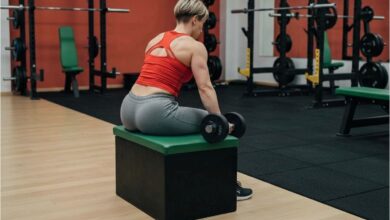
Stand on the box, place your left foot at the right edge, and keep your right foot in the air next to it. Hold the weight in your right hand. Gently lower your right foot to the ground, lightly touching the floor, then push off and return to the box (as shown in the photo). Perform the required repetitions and switch sides. To increase the intensity, hold the weight at shoulder level or above your head.
TRX Suspension Pull-Ups
Targets back muscles , arms, and core stabilizers.
Stand facing the TRX stand and grip the handles with your palms facing each other. Lean back until your arms are fully extended; your body should form a straight line from head to heels, with your core engaged (A). Pull your chest up toward the handles, keeping your elbows tucked in; your arms and neck should remain in a neutral position (B). Hold for a second, then slowly return to the starting position. Repeat.
Deadlifts from a Sumo Squat
The main load is on the glutes and leg muscles.
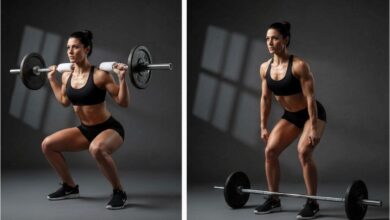
Stand behind a barbell or weighted bar, feet wider than hip-width apart, toes pointed outward. Hinge at the hips, bend your knees, and grip the bar with your hands shoulder-width apart, palms facing your body. Push through your heels, lifting the barbell in front of you to hip height, squeezing your glutes at the top (see photo). Slowly lower the weight to the floor. Repeat.
“Farmer’s” Walk
Engages the muscles of the shoulders, back, legs, and core.
Stand up straight, holding a heavy kettlebell or dumbbell in your right hand. Maintain good posture and walk forward for 30–60 seconds, keeping your center of gravity level and your hips and shoulders parallel to each other. Then switch hands and repeat the movement.
Medicine ball wall throws
Engages the muscles of the arms, chest, back, glutes, and legs.
Stand about a meter away from a wall with your feet shoulder-width apart, holding a medicine ball with both hands in front of your chest. Lower into a deep squat, pushing your hips back (A). Explosively push off with your heels, straightening your arms and throwing the ball high toward the wall (B). Catch the ball and immediately return to the squat. Repeat.
Kettlebell swings
Works the shoulders, chest, back, abs, glutes, and hips.
Stand with your feet wider than hip-width apart, toes turned out, grip the kettlebell with both hands and hold it in front of you at hip level, abs engaged. Lean forward from the hips, allowing the kettlebell to swing freely between your legs, slightly bending your knees and pushing your hips back (A). With an explosive movement, push your hips forward, lifting the kettlebell up to shoulder height (B).
Allow the kettlebell to return smoothly to the starting position, keeping your core engaged. Repeat.
Reverse lunges with barbell lift
This exercise targets the shoulders, back, glutes, and legs.
Stand in front of a long barbell, with one end resting on the weight plates. Grasp the free end of the barbell with your left hand and hold it at your left shoulder, with your elbow pointing down. Take a wide step backward with your right foot and lower yourself into a lunge until your knee is at a 90-degree angle; the barbell should rest on your shoulder, and your right hand should be on your waist (as shown in the photo). Return to the starting position while simultaneously lifting the barbell up with one hand. Hold for a second, then repeat the lunge. Perform the desired number of repetitions, then switch sides.
Lateral pull-downs with resistance band
Engages core muscles
secure one end of the resistance band at chest height to a fixed surface or attach it to a cable machine. Stand with your left side facing the anchor point, feet hip-width apart, knees slightly bent. Grasp the free end with both hands and hold it against your chest, feeling tension in the band (A). Extend your arms diagonally to the right while resisting the tension (B). Bend your elbows to return to the starting position. Repeat the exercise. Perform the required number of repetitions and switch sides.
Three effective ways to finish your workout
- Finish your workout with kettlebell swings. Perform the exercise for one minute per arm. Set a timer and aim to do 20 swings in 60 seconds. If you finish the set early, use the remaining time to rest. Repeat until you reach 100 repetitions.
- Finish your workout with a set of burpees—7 reps per minute, for a total of 35 reps. Set a timer and aim to complete 7 reps in 60 seconds. If you finish early, use the extra time to rest. Keep going until you’ve completed the full set.
- Kettlebell squat variation — 10 reps per minute, for a total of 50. Set a timer and try to do 20 squats in 60 seconds. If you finish early, use the time to rest. Repeat until you complete the full set.
Helpful tips to maintain your results:
- Hydration. Drink water before, during, and after your workout — this will maintain your energy levels and help prevent dehydration.
- Nutrition. Consume protein and carbohydrates in the right balance for optimal muscle recovery and energy replenishment.
- Keeping a workout journal record the exercises you’ve done, the weight, and the number of repetitions to track your progress and adjust your program in a timely manner.
- Mental aspect. Organize your thoughts and set specific goals—this will boost your motivation and help you stay on track.