Pilates at Home
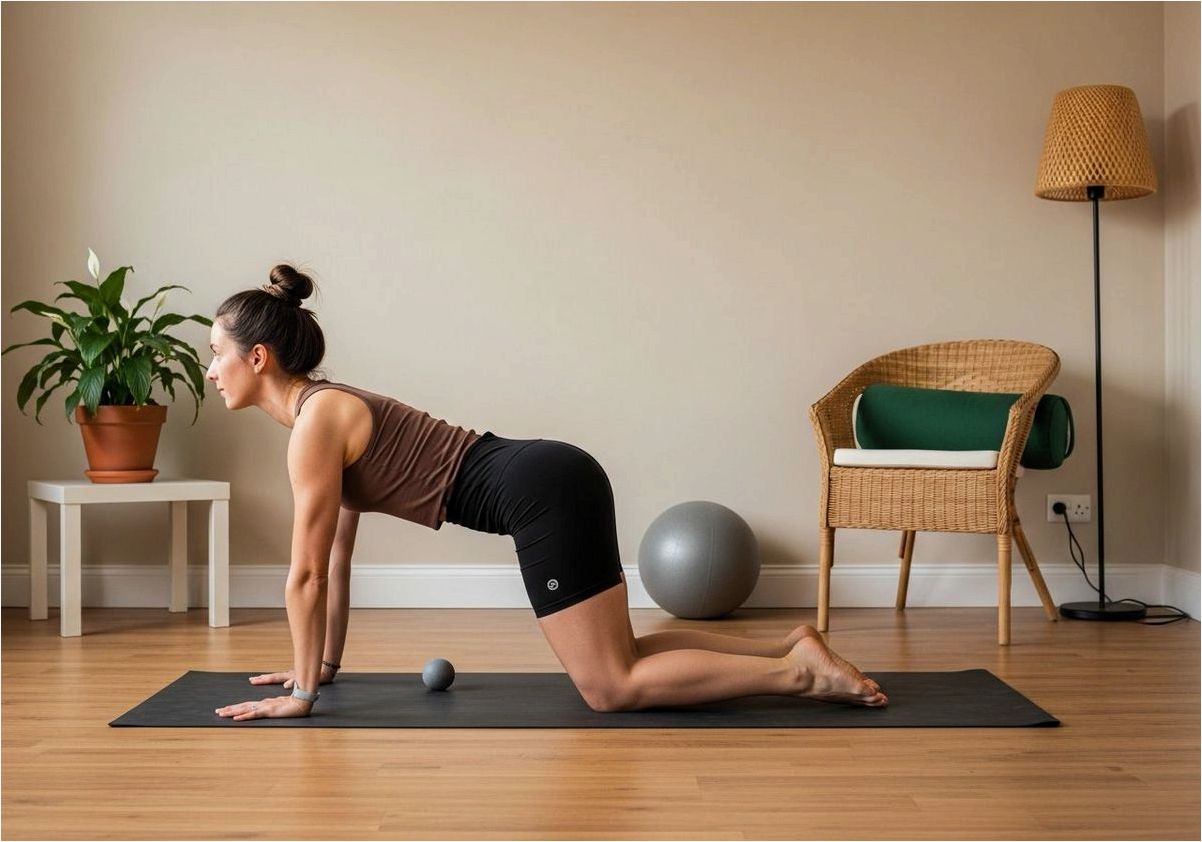
Pilates can help you lose weight effectively, improve posture , strengthen your core, enhance spatial stability, and develop the ability to control your body through mindful movements.
Article Contents:
you can easily practice this method on your own, right at home. The step-by-step program provided will help you master the challenging techniques of Pilates, even if you’re new to it.
“THE HUNDRED”
This activates the muscles of the core, hips, legs, and arms.
Lie on your back, place your arms alongside your body, bend your knees, and pull your legs toward your chest (A). Lift your torso while twisting forward and straighten your legs, pressing your lower back against the floor. Extend your arms forward, parallel to the floor, keeping them above the surface (without touching the floor), and vigorously perform short, springy arm swings up and down with a small range of motion: inhale for 5 swings, exhale for the next 5 (B). Continue for 100 swings.
Is it hard? If you can’t do all 100 swings at once and can only manage 50, should you keep going?
Not at all! This exercise is definitely beneficial, as it’s a great way to warm up your muscles. With each workout, you’ll see noticeable progress—you’ll be able to increase the number of swings by at least 2–3 until you reach 100. To make it easier, you can bend your knees at a right angle.
BALANCE
This exercise works your core muscles.
Sit on your buttocks, pull your bent knees toward your chest, grab your shins with your hands, and lean forward with a rounded back. Lift your feet off the floor and maintain your balance by balancing on your tailbone for 7–10 seconds, trying to keep your legs as close to your body as possible (see photo). Then return to the starting position. Repeat 6 times.
ALTERNATING LEG STRETCHES
This exercise engages the abdominal, back, leg, and gluteal muscles; it stretches the leg muscles.
Starting position: Lie on your back with your legs together. Pull your right thigh, bent at the knee, toward your chest, holding it with your hands (A). Lift your straight left leg off the floor, lifting your shoulder blades off the surface, and hold it for 8–10 seconds (B). It is important to ensure that your lower back is pressed firmly against the floor and your abdomen is pulled in. Your torso should not shift. Repeat 6 times on each side.
Is it hard? I try to “pull my stomach in” (pressing my belly button toward my spine), but I often lose my form. How do I keep my abs engaged properly?
It’s easy! Leaning your back and buttocks against a wall will help you master the scoop technique. Stand close to the wall, press your back and buttocks against it, pull your stomach in, and press your lower back firmly against the wall, tilting your pelvis slightly forward. Hold this position for 30–40 seconds, remembering the sensation. Then try to replicate it while performing exercises on the mat.
LEG STRETCHES TOGETHER
This exercise engages the abs, thighs, and glutes; it stretches the muscles of the entire body and lengthens the spine.
Lie on your back, bring your knees bent toward your chest, and wrap your hands around your ankles (A). Lifting your shoulder blades off the floor and raising your head, as you inhale, straighten your legs to a 45° angle and simultaneously reach your hands behind your head (B). As you exhale, return to the starting position, rolling your arms in a circle through the sides. Repeat the movement 10 times.
“THE CORNER”
This exercise works the abdominal, back, thigh, and gluteal muscles; it stretches the back muscles.
Lying on your back, lift your legs to a 45° angle (press your lower back against the floor), with your arms extended behind your head. As you inhale, lift your torso and reach toward your feet with straight arms, keeping your arms parallel to your legs (see photo). Balance on your tailbone. As you exhale, slowly return to your back, gradually extending your spine from the tailbone. Perform 3–4 repetitions.
BACK STRETCH
This exercise engages the abdominal, thigh, and gluteal muscles; it stretches the back and hamstrings and lengthens the spine.
Sit on your buttocks with a straight back, legs bent at the knees, toes pointing toward you, and feet slightly wider than shoulder-width apart. Extend your arms forward parallel to the floor (A). As you inhale, draw your abdomen in and reach upward with the crown of your head, lengthening your spine. As you exhale, tuck your chin toward your chest and lean forward (B). Return to the starting position, gradually straightening your back from the tailbone. Repeat 3–5 times.
WALL SQUATS
This exercise works the thigh muscles and stretches the back muscles.
Stand with your back against the wall, feet shoulder-width apart. Step your feet forward at a 45° angle relative to your body (A). As you inhale, slide your back down the wall and bend your knees to a 90° angle while simultaneously extending your arms forward (B). As you exhale, rise smoothly, keeping your spine pressed firmly against the wall. Repeat 5 times.
Is it hard? I find it difficult to breathe steadily during Pilates classes which is more important—getting my breathing right or maintaining proper form?
It’s easy! Chest breathing is an important part of your workout , which improves the function of your respiratory muscles and helps prevent congestion in the lungs; however, the primary goal is to perform the exercises correctly to avoid injury. First, focus on technique, and only after mastering it should you move on to breath control. A deep inhalation should be gentle, with the upper spine stretching and the ribs expanding, followed by a full exhalation. At the beginning and end of your workout, perform 10–15 breathing cycles to gradually get used to proper breathing.
SIDE LEG LIFTS
The muscles of the legs, hips, glutes, abs, and back are actively engaged; the leg muscles are stretched.
Lie on your left side with your back straight. Rest your left arm on your elbow, placing your head on your palm; your right arm is bent at the elbow, with your hand resting on the floor next to your torso. Extend your legs at a 45° angle from your body, keeping them tightly together and pressed against the floor (A). Slowly lift your right leg as high as possible (B), then lower it smoothly, applying resistance. Make sure your torso and pelvis do not move. Perform 5–7 repetitions, then switch sides.
SHOULDER BRIDGE
Engages the abdominal, back, leg, and gluteal muscles; stretches the hips.
Lie on your back with your arms at your sides and your knees bent. Tighten your glutes and lift your pelvis, pressing your palms into the floor (A). As you inhale, straighten your right leg and lift it as high as possible, keeping your pelvis level and parallel to the floor (B). As you exhale, slowly lower your leg, extending it from the hip. Make sure your lower back doesn’t round. Repeat 3–5 times, then switch legs.
LEG SWINGS FORWARD AND BACK
This exercise engages the abdominal, back, thigh, and gluteal muscles.
Kneel down and place your right hand on the floor—your wrist should be directly under your shoulder. Bend your left arm behind your head, with your elbow pointing upward. Pull your stomach in. Lift your left leg, straightening it until it is parallel to the floor (see photo). Make sure your pelvis doesn’t shift backward. Swing your leg forward and backward, keeping your torso still. Repeat 3 times and switch legs.
Is it hard? It’s difficult to keep your glutes engaged during exercises. How can you learn to do this?
It’s simple! When the trainer says “Glutes—lift,” they mean engaging the gluteal muscles if your muscles are weak, it’s hard to keep them engaged for long. Before starting the exercise, relax your whole body and focus only on your glutes. Gradually increase the duration of the contraction with each repetition. Do 15 sets.
TORSION EXERCISES
This exercise engages the abdominal and back muscles; it stretches the back muscles and lengthens the spine.
Sit on your buttocks with your back straight, legs shoulder-width apart and slightly bent. Extend your arms out to the sides parallel to the floor, bringing your shoulder blades together. As you inhale, pull your abdomen in, lower your shoulders, and extend your neck (A). As you exhale, twist your torso to the left (B). Return to the center, then twist to the right. Do 3–5 repetitions on each side.
“MERMAID”
This exercise engages the abs, back, hips, and arms; the body is fully stretched.
Sit on your left hip with your legs bent. Rest your left palm on the floor, and extend your right arm upward (A). Assume a side plank position supported by your left arm, with your feet together and your right arm extended behind your head, then lift your hips (B). Return to the starting position and repeat 2–3 times, then switch sides.
Is it difficult? In most exercises (such as wall squats and trunk twists), you need to keep your back straight with a natural curve. Why is this necessary, and how do you maintain the correct posture?
A simple solution! The power house pose, in which your shoulders and hips are aligned, prevents excessive arching in the lower back and protects your spine from injury. Stand up straight, reaching the crown of your head upward, as if you were being pulled by an invisible string. Don’t bring your shoulder blades together or round your back; slightly tuck your pelvis under yourself.