10 Effective Asanas to Include in Your Practice
Yoga is a great way to improve flexibility and tone your muscles. However, asanas are not just Eastern exercises ; each pose has a specific healing effect on the body. We’ve selected 10 simple yet effective asanas that will help improve your health and well-being.
Article contents:
- how to do it correctly. Practice each pose slowly and mindfully, holding the final position for 20–30 seconds or for as many breath cycles as indicated. It is important to observe your body’s response: when performed correctly, the asana helps relieve discomfort and improve your condition.
1. Mountain Pose
Benefits: revitalizes your energy, improves concentration, and relieves fatigue.
Stand up straight with your feet together and your big toes touching. Extend your legs, bring your palms together, bend your elbows, and raise your arms so that your joined thumbs are level with your collarbones. Pull your shoulder blades down, engage your thigh muscles, tighten your core, and gently tuck your tailbone under. Hold the pose for a few seconds, then relax and gently shake your arms and legs. Repeat the exercise twice.
- Instructor’s comment: “If you breathe incorrectly, the benefits of the asana are significantly reduced,” notes Vladimir Chursin, a Hatha Yoga instructor with the “Yoga Federation” network. — Master yogic breathing: inhale slowly, first with your abdomen, then with your chest, filling your lungs to the maximum. Exhale smoothly, relaxing first your chest, then your abdominal muscles your breath should resemble a gentle wave—from the abdomen to the chest and back. To concentrate better, it is sometimes helpful to close your eyes».
2. «Cobra»
Benefits: helps prevent back problems and relieves tension in the lower back.
Lie face down with your toes together and pointed. Place your palms at shoulder level and, using them for support, gently lift your shoulders and chest upward as you inhale, while extending your chin forward and upward. Make sure your hands do not move from their position. Hold this position for a few seconds, then relax. Repeat 2–3 times.
- Instructor’s note: “Imagine that your legs are the powerful tail of a reptile,” advises Rodney Ye, a yoga instructor with the Urban Zen Initiative. “Mentally lengthen and straighten your spine. Complete the pose by gazing upward. This technique effectively helps prevent sciatica attacks.”
3. “Butterfly”
Benefits: normalizes blood flow to the pelvic organs and alleviates PMS symptoms.
Sit upright, bringing the soles of your feet together in front of you as close as possible to your groin; keep your torso vertical without leaning forward. Grasp your feet with your palms and spread your knees apart. Take a deep breath; as you exhale, gently lean forward, relaxing your shoulders while keeping the outer edges of your feet in contact. Hold the position, then inhale and lift your torso. Repeat the exercise 2–3 times.
- Instructor’s comment: “This asana is excellent for strengthening the inner thigh muscles and thereby supports the health of the genitourinary system,” explains Vladimir Chursin. “I especially recommend it in the fall, when the body is still adjusting to the cold after summer. To enhance the effect, gently press your elbows against your knees, trying to lower them closer to the floor—this helps increase muscle elasticity and improve muscle tone.”
4. “Triangle”
Benefits: Improves coordination and strengthens balance.
From Mountain Pose, step your right foot back about a meter, turning the toes slightly outward (about 30 degrees). Your left heel should be in line with the arch of your right foot. Open your hips, turning your torso to the right, and raise your arms to shoulder height with palms facing down. As you exhale, lean to the left, keeping your torso nearly parallel to the floor and your legs straight. Turn your right hip slightly outward, raise your upper arm toward the ceiling, and place your lower arm on your shin. Turn your head and look at your raised right hand. Hold the pose for 3–5 breaths. As you inhale, return to the starting position. Repeat on the other side. Do 2 sets.
- Instructor’s comment: “This asana helps clear the mind and relieves nervous tension,” adds Vladimir Chursin. “In everyday life, we rarely perform side bends, so many muscles don’t get enough exercise. Lack of exercise leads to weakness and problems with the musculoskeletal system. To avoid this, I recommend practicing the ‘triangle’ 2–3 times a day.”
5. Tree Pose
Benefits: strengthens the knee joints and reduces the risk of injury.
Stand in Mountain Pose. Press your right foot against the inner thigh of your left leg (support it with your hands if necessary). Open your left leg out to the side; if this is difficult, place your foot on your shin or knee. Bring your palms together at your chest, with your thumbs touching, or extend your arms upward. Hold the pose, then gently lower your leg and repeat on the other side.
- Instructor’s note: “Yoga has a beneficial effect on the joints, especially the knees,” notes Sandy Blain, author of *Yoga for Healthy Knees*. “Balance poses, including the ‘tree pose,’ help engage the quadriceps, calves, and shins, improving blood flow and keeping the ligaments toned. Regular practice helps prevent age-related conditions and reduces the likelihood of injury, which is especially beneficial for runners.”
6. Child’s Pose
Benefits: reduces overeating and relieves compulsive hunger.
Sit on the floor with your heels under your buttocks. Spread your knees hip-width apart; your big toes should touch. As you inhale, gently lean forward, lower your forehead to the floor, and extend your arms forward. Hold the pose for a few seconds, then return to the starting position. Repeat three times.
- Instructor’s note: “Many people tend to cope with stress by eating, especially sweets,” says Tara Munro, a weight management specialist and yoga instructor from Texas. “This pose helps calm the mind and distract you from compulsive cravings. Practice it when you feel the urge to snack due to emotional tension. If hunger strikes you in an inconvenient place, leaning toward your feet will gently calm your appetite.”
7. “Seated Twist”
Benefits: Promotes normal digestion and improves intestinal motility.
Sit on the floor with your legs extended in front of you. Bend your right leg and place it close to your left knee. Place your right arm behind your back, and clasp your right thigh with your left hand, gently pressing your leg toward your torso. Take a deep breath, exhale, and rotate your torso to the right. Hold the pose for a few seconds, then release your leg. Repeat on the other side. Perform 2-3 repetitions.
- Instructor’s comment: “Turns activate the gastrointestinal tract, which is associated with tension in the oblique abdominal muscles. They gently massage the organs and stimulate their functions,” explains Vladimir Chursin. “This pose is easy to master and is suitable for beginners and those who suffer from colic or gastritis.”
8. “Downward_Dog”
Benefits: Improves thyroid function, increases alertness and mental clarity.
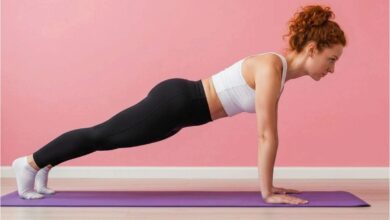
Starting position: plank. As you exhale, sharply straighten your arms, draw your feet closer to your head, and lift your pelvis, forming an inverted V. If necessary, move your legs even closer to your hands, trying to place your heels on the floor. Inhale, relax your head, and hold this position for 3-4 breaths. Then return to the starting position. Repeat 3-4 times.
- Instructor’s comment: “This asana improves blood circulation in the upper body, saturating the tissues with oxygen and activating thyroid function,” explains Vladimir Chursin. “It has a beneficial effect on the kidneys, liver, and back muscles. It is recommended even for those who don’t practice yoga as an effective stretching exercise.”
9. Warrior Pose I
Benefits: Improves respiratory function, prevents asthma and allergy flare-ups, and strengthens the immune system.
Stand up straight with your feet wider than shoulder-width apart, parallel. Rotate your heels to the left. As you exhale, bend your left knee at a right angle so that your knee is directly over your foot. As you inhale, join your palms and raise your arms up, stretching your body from the heel of your right foot to your fingertips. Hold the pose for 30 to 60 seconds, then return to the starting position and repeat on the other side. Do 2-3 repetitions.
- Trainer’s opinion: “This pose keeps the head above the heart, which prevents excess blood flow to the upper body and relieves tension in the respiratory system,” explains Baxter Bell, MD, an acupuncturist and yoga instructor in Oakland, California. “It is recommended for those with seasonal allergies or asthma.” “Because this pose expands the chest, it helps relieve bronchitis,” adds Vladimir Chursin. “It is advisable to practice it regularly during cold season.”
10. Chair Pose
Benefits: Strengthens bones and reduces the risk of early osteoporosis
Starting position: Stand up straight with your feet shoulder-width apart, knees in line with your heels. Exhale and bend your knees, as if you were about to sit down on an invisible chair behind you. As you inhale, raise your arms up, keeping your forearms parallel to each other and your palms together. Hold this position for 2-3 breaths, then smoothly return to the starting position. Repeat 2-3 times.
- Trainer’s opinion: “Chair Pose actively engages the muscles of the back, hips, glutes, and calves. Additionally, the body is held in a slightly unstable position, which promotes effective strengthening of the skeletal system,” says Lori Rubenstein, lead instructor of the Yoga Therapy Rx program at Loyola Marymount University. “It’s helpful for younger women to regularly include this pose in their exercise, because osteoporosis is affecting younger people today and can manifest itself as early as age 30.”