E-Additives: What Food Manufacturers Don’t Want You to Know
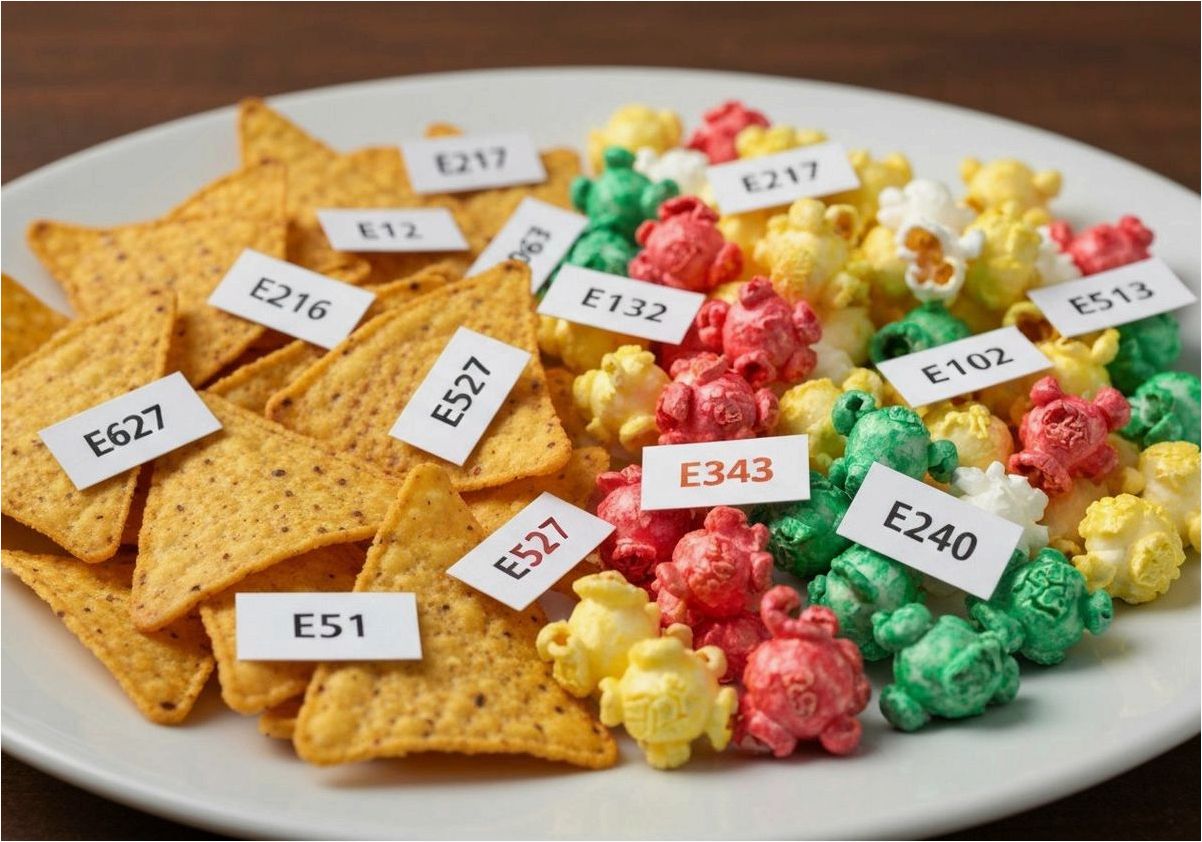
In today’s society, the term “food additives” causes concern for many. But how justified are these fears? Experts say the situation is much more complex than it seems at first glance. An “E” label doesn’t always mean danger! Which additives can actually harm your health, and are there any preservatives that are safe for the body? Let’s figure it out with the experts!
Article Contents:
First, it’s important to understand that the “E” code is not a death sentence. It indicates that the additive is approved for use in EU countries and has passed certain safety tests. Food additives are divided into several groups: colorings, preservatives, antioxidants, stabilizers, and others. Many of them perform important functions, such as preserving food freshness, preventing bacterial growth, and enhancing flavor.
However, there are certain categories of additives that should be used with caution. For example, some artificial colors and preservatives can cause allergic reactions or negatively impact the nervous system if consumed in excess. These include, for example, E102 (tartrazine) and E211 (sodium benzoate).
Experts advise carefully reading product ingredients, choosing those that contain natural or extremely safe additives, such as ascorbic acid (E300) or lecithin (E322). Furthermore, it’s important to exercise moderation and avoid overindulging in processed foods to avoid placing additional stress on the body.
Overall, understanding the role of food additives and making informed food choices will help maintain health and reduce risks. Remember: information is the best defense against unnecessary concerns and myths associated with E-additives.
Origin of Food Additives: from Ancient Times to the Present
The use of food additives is a practice that dates back to ancient times. Our ancestors used salt, vinegar, spices, and lactic acid not only to enhance the flavor but also to preserve food. For example, carmine (E120), obtained from insects, was used as early as biblical times to impart a deep reddish-purple hue to food. However, until the 20th century, food preparation technology relied primarily on natural ingredients, until the industrial development of chemistry led to the widespread introduction of synthetic food additives. Inna Kylosova, Associate Professor of the Chemical Engineering Faculty of Perm Polytechnic University and a PhD candidate in pharmaceutical sciences, explains: “New compounds can completely transform the appearance, taste, color, aroma, texture, and properties of products. Dyes create vibrant colors, flavors reproduce desired aromas, and preservatives extend shelf life.”
Many food additives have complex and lengthy names, making them difficult to label. To simplify the process and make it understandable for consumers, the European Union developed a special coding system: each additive is assigned a unique number beginning with the letter “E” (symbolizing Europe), followed by numbers indicating the group and specific substance.
These codes are responsible for prolonging the freshness of products and also improve their appearance, texture, aroma, and flavor. In Europe, additives are classified using numerical designations under the letter “E,” which facilitates their identification and ensures compliance with standards. The numbers in the codes group substances according to their functional purpose.
Currently, additives are divided into several broad categories:
- Colorings (E100-182) — responsible for the brightness and saturation of colors,
- Preservatives (E200-299) — ensure long-term storage,
- Antioxidants (E300-399) — protect products from oxidative damage,
- Stabilizers and thickeners (E400-499) — form the desired density and texture,
- Emulsifiers (E500-599) — create homogeneous mixtures,
- Flavor enhancers (E600-699) — give dishes a brighter and more attractive taste,
- Foaming agents (E900-999) — technical additives that prevent the formation of unwanted foam during Production.
It is important to note that all food additives used in the European Union undergo a rigorous safety assessment process, which includes toxicological testing and studies of their potential impact on human health. Only after safety is confirmed does the additive receive approval for use and an associated “E” number. Furthermore, regulatory authorities regularly review lists of approved substances, excluding those deemed unsafe or obsolete.
Current trends in the food industry are focused on the use of natural and organic additives derived from plant and mineral sources. This is due to growing consumer demand for healthy eating and the minimization of artificial ingredients in products. Furthermore, research is underway to develop functional additives that not only improve organoleptic properties but also have positive health effects, such as strengthening the immune system or improving digestion.
It is also worth mentioning that the correct and moderate use of food additives plays a key role in ensuring food safety and quality. Their use helps prevent food loss, reduce food waste, and promotes innovative nutritional approaches, such as specialized diets and extended-shelf-life products.
Food additives: truth and fiction about their harm
Not all substances marked with the letter “E” are dangerous. Many of them are natural compounds found in natural products. For example, apples contain ascorbic acid (E300), pectin (E440), and riboflavin (E101). However, even natural ingredients can be harmful if consumed in excess. For example, excess vitamin C or A can cause hypervitaminosis, which has negative consequences for the body. As for synthetic additives, when used within established standards, they are not always harmful, but an excess of flavor enhancers, colorings, and preservatives can lead to addiction to certain flavors and negatively impact health.
Which additives can be dangerous?
Some food additives can have adverse effects on the body. Monosodium glutamate (E621) is safe in small doses, but excesses can cause toxic effects on the liver and pancreas, as well as headaches, allergies, and a certain dependence on products containing it. Preservatives with codes E221-226 and E338-341 can negatively impact digestion, while colorings E102, E107, E122-124, E155, and preservatives E211-214 can trigger asthma attacks and allergic reactions. Furthermore, studies suggest a possible link between certain substances, such as E954 and E126, and cancer development.
Unexpected components in food
Few people know that carmine coloring (E120) is derived from insects, and shellac, which gives candy and baked goods their shiny sheen, is based on the secretions of the lac bug. The dye E129, found in carbonated drinks, is made from coal tar—the same substance used in lice shampoos. Despite this, its use in the food industry is officially permitted.
Food Additives and Chronic Diseases
Each supplement undergoes rigorous safety testing. Long-term animal and human studies help determine safe intake levels. For example, the acceptable dose for sodium nitrite is 0-0.2 mg per kilogram of body weight, aspartame is 0-40 mg/kg, and monosodium glutamate is 0-120 mg/kg. “Exceeding the established limits can lead to unpleasant consequences, but when following the guidelines, it is important to consider the total intake of all supplements,” emphasizes Inna Kylosova.
Children’s Food Features: Myths and Reality
Only natural flavors are allowed in children’s food products, while sweeteners, benzoic and sorbic acids, hydrogenated oils, and GMOs are prohibited. Parents are advised to carefully read the ingredients in baby food, as even natural ingredients, when consumed in excess, can accumulate and negatively impact a child’s health.
Label Reading Rules
When choosing products, it is important to carefully read the ingredients list: ingredients are listed in descending order of quantity. The shorter the list of ingredients, the better. Attractive names like “sunset” or “magic red” often conceal artificial colors. Don’t blindly trust the “natural flavor” label, as its chemical composition may be identical to that of a synthetic alternative. Pay particular attention to products containing sweeteners and low-fat options, as they often contain added carbohydrates and stabilizers.
Also, pay attention to the production date and expiration date—fresh products retain more nutritional value and contain fewer harmful additives. Quality certificates and ingredient origin labels are helpful indicators. Avoid products with confusing or overly long names or those containing preservatives with E numbers (e.g., E210–E219), as some can cause allergic reactions. Remember to check the salt and sugar content: high levels can negatively impact health with continued use. Whenever possible, choose minimally processed and GMO-free products, which are often indicated on the packaging.
Results
Food additives are not necessarily harmful, but they require careful use. Avoid excessive flavor enhancers, synthetic colors, and preservatives, carefully read the ingredients of the products you buy, and choose natural ingredients. This approach will help maintain your health and reduce the risks associated with unwanted additives.