Perfect Looks for Your Body Type: A Practical Guide
Just as there is no such thing as “bad” weather in nature, there is no such thing as a “bad” body type for women—it’s all about choosing the right clothes. Elena Panova, designer, stylist, and founder of the TEMPELESS brand, will help you figure out your body type and offer practical advice on building the perfect wardrobe.
Article contents:
Four universal rules that always work
These simple recommendations will help you highlight your strengths and conceal your flaws.
- The right size. To accentuate your curves, it’s important to choose clothes that fit your figure perfectly. Clothes that are too large or oversized will add bulk and make your silhouette less defined, sometimes visually transforming you into a rectangle, and at times even a square. If your clothes are too small, that’s not flattering either, making your look awkward and restrictive.
- The perfect balance between comfort and style. Clothing should be comfortable and bring joy. Fashion isn’t about discomfort—it’s about beauty. However, comfort doesn’t mean sacrificing shape or having an awkward fit; it’s important to strike the right balance.
- The right choice of lingerie. The foundation of any beautiful look is the right lingerie. Despite the appeal of lace sets, their main purpose is to provide comfort and support the figure, not to constrict the bust or create unnecessary folds on the back, waist, and hips.
- The key accessory is self-confidence. Unfortunately, many women, hoping to lose weight, hide their favorite outfits and hide behind shapeless clothing—oversized pieces, black tunics, and outdated sweaters. Years go by, but the fear of showing themselves doesn’t go away. In an even more difficult situation, people focus on strict diets, forgetting about their health. But it’s important to remember—every woman is beautiful in the present moment, and each has her own strengths and unique features that shouldn’t be hidden, but rather highlighted through clothing. A little self-care will help you find your perfect style.
How to determine your body type: five main options
Take an objective look at yourself, without being overly critical: assess your measurements, including your height, bust and hip measurements, and the shape of your stomach. Think about which parts of your body you’d like to highlight.
- “Apple” or oval body type: full bust, pronounced stomach, hips of varying widths.
- “Rectangle” body type: bust, waist, and hips are nearly equal in size; the waist is often not clearly defined; the silhouette appears slender and even. This type is sometimes called “model-like.”
- “Pear” Body Type: Wide hips, narrow waist, flat stomach, small and narrow shoulders, modest bust.
- “Hourglass” Body Type: Large bust and hips, narrow waist.
- “Triangle” body type: characterized by broad shoulders, which give the figure a slightly masculine appearance.
Of course, this classification is quite general—other factors, such as age, height, posture, neck length, and body proportions, also influence clothing choices. Knowing your body type will help you build a wardrobe with confidence and awareness.
Now let’s move on to the most important part—a practical guide to consult before every purchase at online stores or boutiques.
“Apple” body type (oval)
Women with this body type are quite common. Their distinctive features include a short neck, gently sloping shoulders, a full bust, a pronounced belly, and often full or medium-sized hips.
For this body type, there are two main approaches to creating a look:
- Focus attention on the figure;
- Redirect attention to the clothing.
The first approach is similar to the plus-size style—designers choose thick, silhouette-enhancing garments. The second approach is classic, featuring tried-and-true elements: layering, tops and blouses with V-necklines, as well as wrap dresses, jackets, and coats.
Opt for a V-neckline, which visually lengthens the neck and flatters the bust. For shirts and blouses, make sure the middle button sits at the bust line. Pants and jeans should have no excess fabric at the waist, not be too tight, and not be overly narrow. A straight, slightly loose cut is ideal, perhaps with pleats. The ideal length is cropped. Skirts should be straight, fitted, and just below the knee. Don’t be afraid to show off your legs: in warmer weather, pair them with shoes or loafers; in winter, with tall, loose-fitting boots. Outerwear can be further accentuated with a belt—thin or wide, made from the same material as the coat.
Give preference to small patterns: checks, polka dots, abstract prints, and gradients. Use stripes sparingly and with caution.
“Rectangle” body type
There is an important nuance here that is often overlooked—your level of slimness. It largely determines your approach to choosing clothes. Slender and tall women with this body type, like Nicole Kidman, can pull off almost anything. It is precisely these models who often walk the runways, as designers consider the slightly angular silhouette of the “rectangle” to be the ideal.
The slender “rectangle”: the tall and slim body type is a stylist’s dream. Practically any style suits them—from skinny jeans to wide, classic trousers with pleats at the waist.
Skirts and dresses can be of any style and length—mini, midi, maxi, fitted or loose, pencil, A-line, tulip—all options are in style.
Jackets and coats with an emphasis on the shoulders, as well as loose, men’s-style jackets, look great on these body types.
Petite, slender women should keep a few tips in mind: it’s best to choose long pants with a fitted top and a flared bottom to visually increase height. Lightweight, loose joggers are also a good choice, while skinny jeans should be avoided.
Skirts and dresses are best worn in mini lengths or just above the knee—midi and maxi lengths can make you look shorter. Women of short stature, regardless of body type, should avoid layered and overly voluminous outfits.
Full “rectangle”: Women of this subtype tend to gain weight around the waist, upper abdomen, and thighs. At the same time, their bust usually remains prominent, and their legs remain slender.
In this case, follow the advice for the “apple” body type. Additionally, midi and maxi skirts with prints and textured fabrics are a good choice, as they conceal the protruding abdomen and the volume of the hips.
“Pear” body type
Characteristics: narrow shoulders, small bust, and curvy hips.
A common mistake when choosing clothes is trying to balance the upper and lower body using ruffles, frills, and puffy sleeves, which, on the contrary, further emphasize the imbalance in proportions.
It’s more effective to wear circle skirts, especially if you have a slim waist—they create a slimming effect and balance the silhouette. Choose pants that are flared at the bottom, without pleats at the waist, or loose joggers with a low waist, which don’t emphasize the hips but soften the look.
“Hourglass” body type
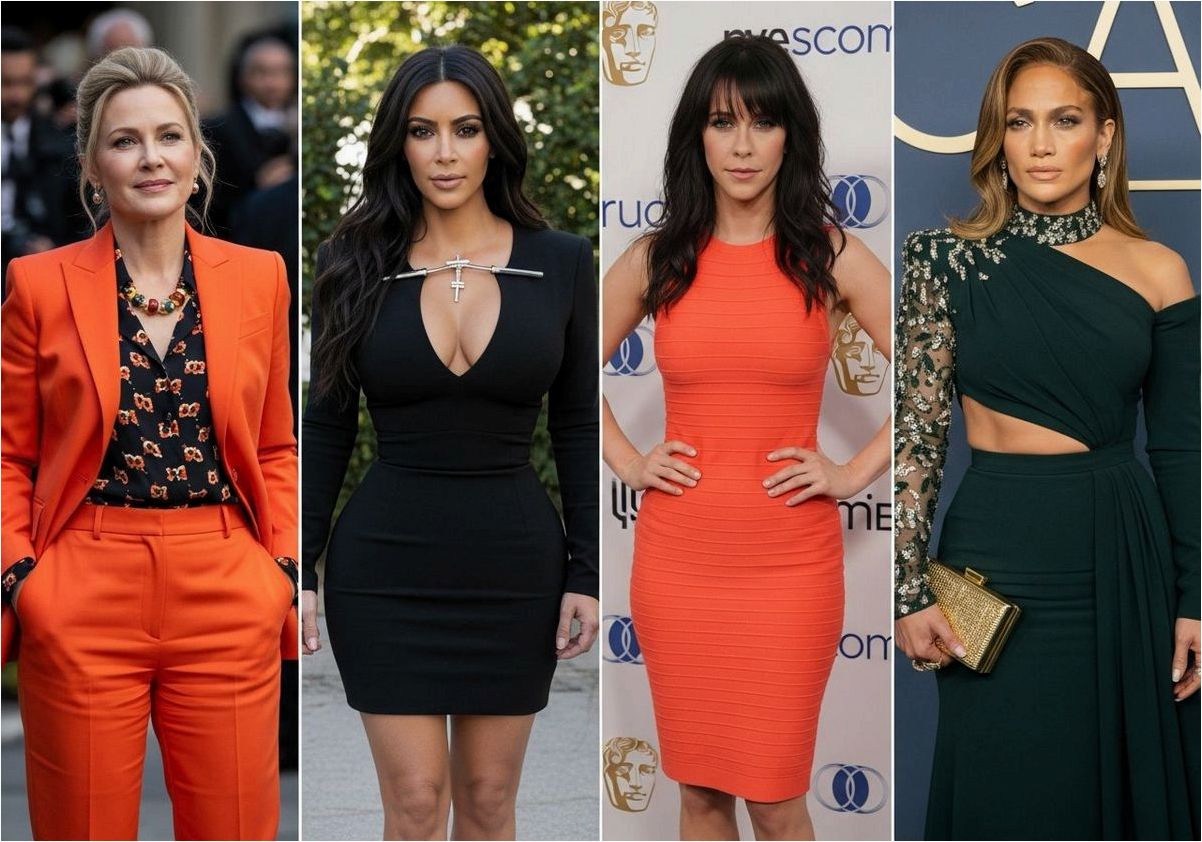
This body type is characterized by a full bust, rounded hips, and a defined, narrow waist. It is the classic ideal, perfectly embodied by celebrities such as Marilyn Monroe, Kim Kardashian, Monica Bellucci, and Scarlett Johansson.
The main goal is not to hide your graceful curves, but to highlight your natural beauty. Avoid shapeless oversized sweatshirts and straight-cut dresses, which distort your proportions and make you look heavier than you are. Opt for fitted styles—sheath dresses with round or V-necklines—as well as heels, which add a touch of femininity.
For pants and jeans, choose a mid-rise or high-rise fit—a high waist is a definite plus for you.
Jackets, coats, cardigans, and down jackets look best when you accentuate the waist with a belt or choose fitted styles that create the most feminine look.
“Triangle” body type
Women with this body type have broad shoulders, a straight waist, and less pronounced hips, as well as, most often, beautiful, long, and slender legs.
The main mistake women with this body type make is trying to balance their proportions with voluminous bottoms, such as wide skirts or draped styles. In reality, this approach only exacerbates the imbalance. Bulky sweaters, hoodies, and sweatshirts are also unsuitable. On the other hand, straight, loose-fitting jackets paired with mini or even micro-mini skirts will give your look expressiveness and balance—this is the ideal option for the “triangle” body type. This style looks chic and is comfortable. Coats and blazers with dramatic, voluminous shoulders are also in style.
Just as with the graceful “rectangle” body type, high- or mid-rise jeans and pants are suitable for this body type: slim-fitting styles, skinny jeans, classic wide-leg pants with pleats at the waist, and “boyfriend” style pants. A low rise can visually shorten the torso, so it’s best to avoid clothing with this cut.
How to create a stylish and flattering look
There are universal techniques that work for almost all women, regardless of body type.
- Vertical lines in clothing. This isn’t so much about color or patterns as it is about less obvious details—vertical rows of buttons, zippers, an open-front long cardigan or jacket, accessories like a draped scarf, creases on pants, stripes, and vertical decorative stitching.
- A monochromatic layered outfit with a matte finish. Complex prints, embellishments, and shiny fabrics add visual bulk, which is undesirable. Monochromatic ensembles with a matte finish make the silhouette appear slimmer and taller. You can choose an entirely solid-color look or play with shades of a single color.
- Jewelry and accessories. You can use them to draw others’ attention where you want it: if you want to divert the gaze from problem areas, highlight the strengths of your look with eye-catching details.
- Handbag. It should be proportionate to your body size. Small handbags on tall women emphasize height, while bulky styles on petite women can make the figure appear smaller. It’s also important to remember that attention is drawn to the part of the body where the bag sits, so adjust the strap length wisely.
- Shoes. Opt for comfortable styles that harmonize with your look. As Charles Perrault wrote in the fairy tale “Cinderella”: “No shoes can make a foot smaller.” This is true from an anatomical standpoint, but with the right choice, you can visually adjust the proportions and even the size of your foot.