Reasons for the decline in balance with age and ways to maintain it
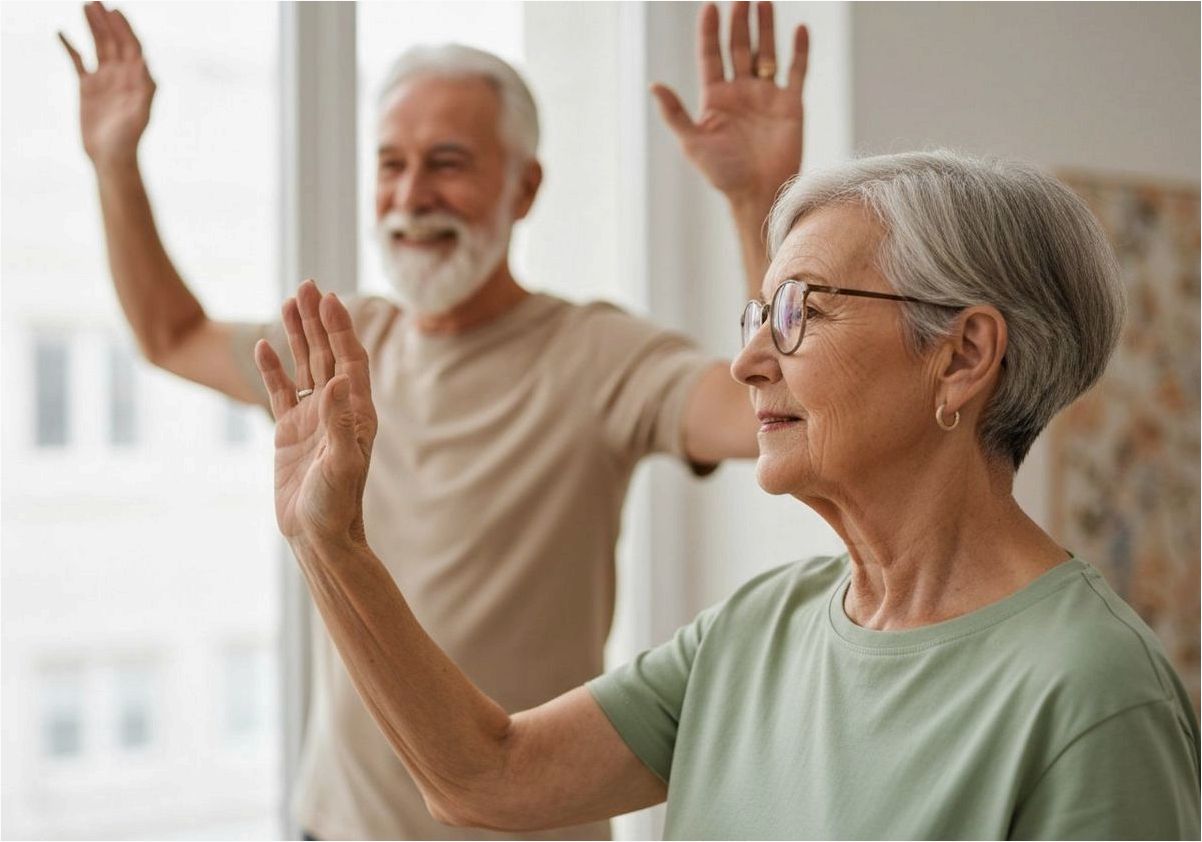
We rarely think about balance until we experience a loss of it. The ability to maintain stability plays a crucial role in health at any age. It helps us not only hold difficult poses, such as the eagle pose on a yoga mat, but also perform simple daily tasks: getting out of bed, navigating stairs, maintaining coordination while walking, and avoiding falls on slippery surfaces.
Article Contents:
- The Importance of Balance for Health
- How the Balance System Works
- The Effect of Age on Balance
- Basic Principles of Balance Training
- 13 Exercises to Improve Balance and Stability
- Single-leg step-ups onto a platform
- Vertical twist with a clap under the foot
- Conclusion: Balance training is accessible at any age
The Importance of Balance for Health
Balance is not only the foundation of physical endurance and quality of life, but also a way to reduce the risk of injury and pain. The ability to maintain balance is critical for performing everyday movements such as walking, running, and standing up from a chair.
Data from a study published in JAMA Network Open in 2021 show that the ability to perform basic movements (such as standing on one leg or getting up from a chair without using one’s hands) directly affects the likelihood of falls, hip fractures, and hospitalizations in people over 50. The poorer the coordination and balance, the higher the risk of serious injury.
Muscle contraction speed, which is responsible for the body’s rapid protective responses in the event of a loss of balance, declines with age nearly twice as fast as overall muscle strength. This fact was confirmed by a team of researchers from McGill University (Canada) in 2017.
Unfortunately, without regular balance training, this process only accelerates. However, the good news is that even short daily exercises can significantly improve stability, regardless of age and initial fitness level.
How the Balance System Works
Maintaining balance while walking, running, jumping, or standing requires not only muscle strength but also rapid muscle contractions that stabilize the body and support the intended movement. Muscles not only provide strength but also hold bones and joints in the correct, upright position. To maintain balance, the body uses three main sensory systems:
- Visual system: gathers information about the environment, allowing the brain to orient itself in space and understand the body’s position relative to external objects. When the eyes are closed, it shuts down, and other systems take center stage. This is why training with eyes closed is considered particularly effective for developing balance.
- Somatosensory system: includes receptors for pressure, touch, and proprioception, which allow us to be aware of our body’s position without visual cues.
- Vestibular system: located in the inner ear, it responds to gravity and acceleration, helping us maintain balance even with our eyes closed.
Information from all three systems is transmitted to the brain, but the visual system usually plays the leading role. As we observe the world around us, the brain quickly checks the body’s alignment with space, which facilitates balance. This explains why many people find it difficult to stand on one leg with their eyes closed. That is precisely why experts recommend exercises with eyes closed—this improves the functioning of the somatosensory and vestibular systems.
The Effect of Age on Balance
After age 30, a natural decline in muscle mass begins—a process called sarcopenia. At the same time, the functionality of all three systems responsible for balance deteriorates. A study published in The Gerontologist in 2018 showed that after age 65, the decline accelerates: vision (including peripheral and depth perception) becomes less acute, receptor sensitivity decreases, and the vestibular nerves undergo degenerative changes.
Another negative factor is the frequent use of gadgets: tilting one’s head downward for extended periods while using a smartphone distorts the body’s alignment, which over time worsens posture and reduces balance, even in young people. This is supported by a 2020 study from the University of Toronto, which found a high prevalence of such issues among students.
Basic Principles of Balance Training
To slow down age-related changes, it is important not only to strengthen muscles but also to regularly work on improving balance. It is similar to learning to play a musical instrument: first, you need to establish a clear connection between the brain and the body, and then constantly maintain and refine it through practice.
Researchers at the University of Illinois (2022) have shown that just 5 minutes of daily balance training improves neuroplasticity and reduces the risk of falls by 40% after just three months.
Consistency is key. Exercise daily if possible, or at least every other day. You can start with simple exercises: standing on one leg while brushing your teeth or picking up objects while holding the other leg behind your back. As you progress, make the tasks more challenging, for example, by lifting your leg higher. If you’re short on space, time, or energy, try this classic exercise: stand on one leg with your eyes closed for as long as possible (time yourself!), then switch legs. Make sure your balance time increases with practice.
To effectively train your balance, include the following movements in your routine:
- One-legged exercises (e.g., pull-ups);
- Exercises in a split stance, such as lunges;
- Unilateral exercises — holding or shifting weight to just one side.
13 Exercises to Improve Balance and Stability
Incorporate these exercises into your daily routine — you’ll notice your stability improving, muscle tension decreasing, and your posture becoming more correct.
Spinal Alignment
Lie down on a long roll or a rolled-up towel so that it supports your head, spine, and pelvis. Bend your knees and place your arms alongside your body. Relax and lie in this position for 5 minutes twice a day. This will help restore the correct alignment of your body’s axis.
Static Lunges
From a standing position, step forward and bend both knees to a 90-degree angle. Keep your back straight. Repeat 10 times for each leg.
Isometric Lunges (Split Squats)
Get down on one knee and lift it slightly off the floor; hold for 10–30 seconds. Do 2–3 sets for each leg.
Toe Raises
Stand up straight, slowly rise onto your toes, hold at the top, then lower yourself smoothly. Repeat for 3 sets of 10 repetitions.
“Tightrope” Walking
Walk along an imaginary line, placing the heel of one foot directly in front of the toe of the other. Take 10 steps forward and backward; repeat three times.
Standing on one leg with eyes closed
Close your eyes, lift one leg, and maintain your balance. Start with 10 seconds, gradually increasing the duration.
Romanian deadlift on one leg
Slightly bend your supporting knee, lean forward with a straight back, and simultaneously lift your free leg backward. Return to the starting position. Repeat for the other leg.
Plank with shoulder touch
From a high plank position, touch the opposite shoulder with your palm. Try not to rock your hips. Do 10 reps on each side.
“Bird-Dog”
On all fours, extend the opposite arm and leg. Hold the position for 5 seconds, then switch sides.
Side-bending lunge
Cross one leg over the other, lunge forward, and lift your knee while leaning to the side. This exercise activates the oblique muscles of the abdomen. Repeat 12 times on each side.
Single-leg step-ups onto a platform
Stand in front of a step platform, step up onto it with one leg, and lift the opposite knee to hip height. Return to the starting position. Repeat 10 times for each leg.
Vertical twist with a clap under the foot
Lift your bent knee up to your hip, lean forward, and clap your hands under your knee without lowering your leg. Do 10 repetitions on each side.
Tree pose
Place the foot of one leg on the inner side of the other shin. Hold the pose for 20 seconds without rotating your hip. Repeat with the other leg.
Conclusion: Balance training is accessible at any age
Although balance declines with age, this is not a death sentence. Regular training activates sensory systems, strengthens muscles, and reduces the risk of falls. Research published in the Journal of Aging and Physical Activity in 2020 shows that people over 75 can significantly improve their balance in just 6 weeks of training. If you start training earlier, the results will be even more impressive.
Incorporate balance exercises into your daily routine: they’re simple, require no special equipment, and take just 10–15 minutes a day. Your posture, gait, and self-confidence will thank you.